

Yes, you can set up a business in Cameroon without living there. A representative holding your power of attorney files the application, and a company’s managers may live outside the country. The real difficulty is not the setting up. It is running, from a distance, a business that works without you, with accounts you can see and someone you trust on the ground.
At a glance
- Cameroonians abroad sent about 650 billion CFA francs home in 2025 (Ministry of Finance).
- Businesses are registered at the Business Creation Formalities Centre (CFCE). The file can be lodged by a representative.
- Registering a sole proprietorship costs 41,500 CFA francs. A company adds the legal notice and stamp duties (Ministry of Finance).
- The main risk is not administrative. It is money sent with no account, no figures and no control.
- Three decisions to make before you send any money are at the end of this guide.
The scene
A textbook case, not a real client.
A nurse living in Lyon sends 8 million CFA francs to her brother to open a hardware shop in Bonabéri. The business is registered in her brother’s name. Sales are taken in cash. She gets photos of the shop on WhatsApp, and requests for money “for stock”.
Two years later, she does not know how much the shop sells, or what is left of the stock. Nor can she prove anything: nothing is in her name.
Nobody necessarily stole anything. Nothing had been put in place for her to see.
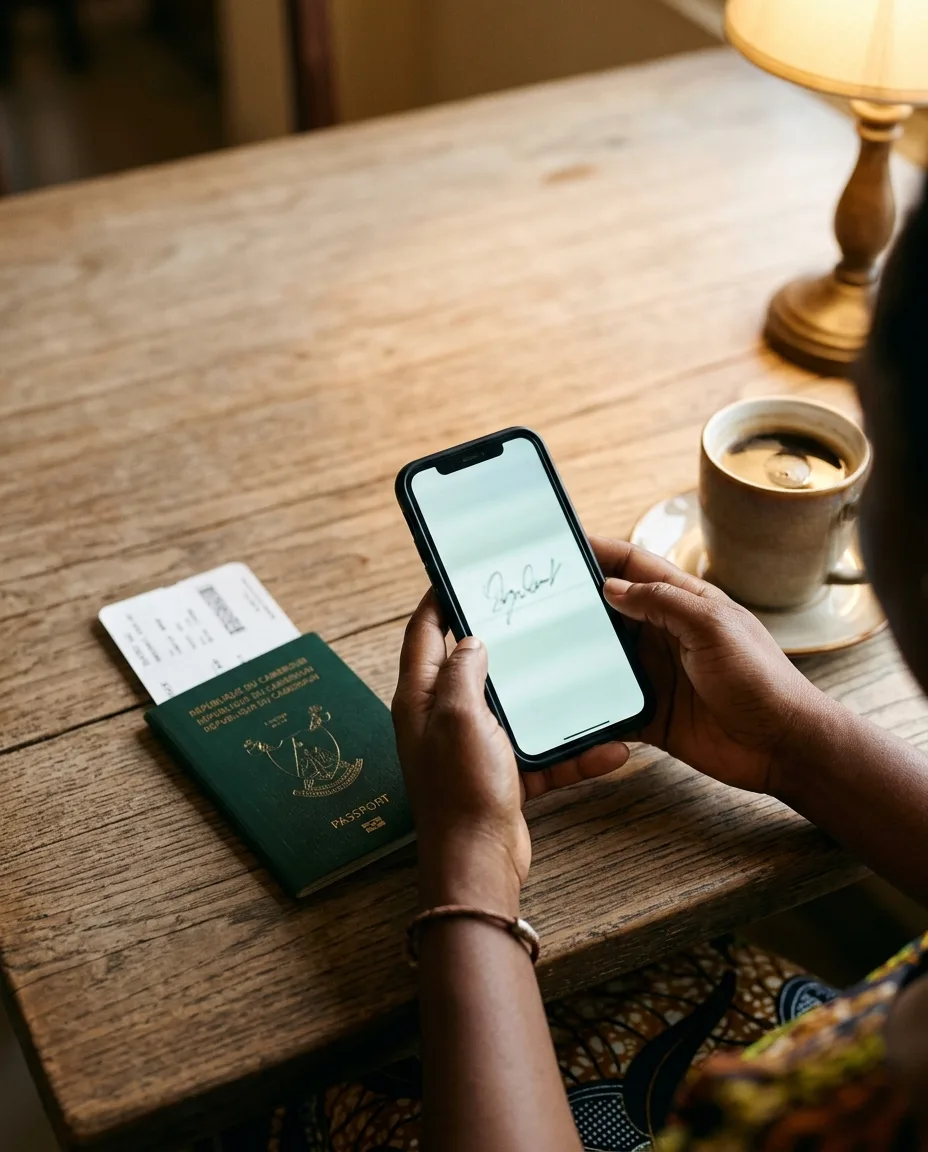
Can you set up a business in Cameroon without being there?
Yes.
At the CFCE, the file is lodged by the founder or by their representative. You sign a power of attorney naming someone you trust and stating what they may do on your behalf. Cameroon’s consulates provide a template.
For a company, the managers may be foreign nationals and live outside Cameroon. There is also an online registration window, MyBusiness.cm.
One thing to check first: your nationality. The 1968 nationality code provides that an adult Cameroonian who voluntarily acquires a foreign nationality loses Cameroonian nationality. If that applies to you, some documents change: for a sole proprietorship, the CFCE then asks for a passport or residence permit instead of the national identity card. Reform has been debated for years. Have your situation confirmed by a lawyer.
Distance does not stop you setting up. It forces you to choose your representative well, and to put their powers in writing.
Which documents should you prepare from abroad?
According to the Ministry of Finance, the CFCE asks for:
Identity
2 copies of the identity card or birth certificate (nationals); passport or residence permit (foreigners)
Copy of the identity card of each partner and of the manager
Criminal record
Extract, or a sworn statement filled in on site
For each partner and the manager, or a sworn statement
Registered address
Location map
Location map, PO box, telephone
Specific documents
Marriage certificate, if married
Articles of association and declarations of compliance, in several copies
Fees
41,500 CFA francs
41,500 CFA francs, plus 13,125 CFA francs for the legal notice and stamp duties
| Sole proprietorship | Private limited company (SARL) | |
|---|---|---|
| Identity | 2 copies of the identity card or birth certificate (nationals); passport or residence permit (foreigners) | Copy of the identity card of each partner and of the manager |
| Criminal record | Extract, or a sworn statement filled in on site | For each partner and the manager, or a sworn statement |
| Registered address | Location map | Location map, PO box, telephone |
| Specific documents | Marriage certificate, if married | Articles of association and declarations of compliance, in several copies |
| Fees | 41,500 CFA francs | 41,500 CFA francs, plus 13,125 CFA francs for the legal notice and stamp duties |
Add the power of attorney for your representative. The location map assumes a real address in Cameroon: premises, or a registered-address service.
Get everything ready before you delegate. An incomplete file goes back to your representative, and from far away every round trip costs weeks.
Sole proprietorship or company, when you live abroad?
A sole proprietorship is you. You are the trader, liable on your personal assets, and your name is on the register. From a distance, that means being able to act yourself day to day, which is rarely the case.
A company separates the roles. You are a partner and own your shares. A manager on the ground acts on the company’s behalf. The articles of association can set the manager’s limits: for example, any spending above a certain amount needs your written approval.
The figures point the same way. Between 2009 and 2016, 40.7% of the sole proprietorships tracked by the national statistics institute (INS) closed, against 31.6% of SARLs. A SARL does not survive because it is a SARL, but it often reflects a better-prepared project.
When you live far away, a company with articles that limit the manager’s powers protects you better than trust alone.
How do you run it from afar without losing your money?
With five rules set on day one.
- 1An account in the business’s name, viewable online. Set a threshold above which two signatures are needed, one of them yours.
- 2No cash sales going into someone’s pocket. Takings go into the account, or into a merchant mobile money account in the business’s name.
- 3Three figures every week: sales, expenses, cash balance. Always the same day, in the same format.
- 4A stock count every month, done or checked by someone other than the person who sells.
- 5A manager with a contract: pay, written targets, a report. Not a relative “doing you a favour”.
Trust does not replace visibility. It needs it.
Before you send any money
- 1
Choose your representative and draw up their power of attorney, stating exactly what they can do.
- 2
Set the rules for the account: in the business’s name, online access, two signatures above a threshold.
- 3
Fix the weekly report: three figures, one day, one format. Before the first franc, not after.
Further reading
Living abroad and want to launch a business back home?
Let’s talk about your project.

Sources (in French)
- Ministry of Finance, “CFCE in brief” (documents and registration fees): minfi.gov.cm
- eRegulations Cameroon, company registration procedure, with the MyBusiness.cm online window (in French): yaounde.eregulations.org
- CMS, “Cameroun : ce qu’il faut savoir pour s’implanter et exporter” (foreign and non-resident managers, in French): cms.law
- Embassy of Cameroon in the United States, power of attorney template (in French): cameroonembassyusa.org
- Law no. 68-LF-3 of 11 June 1968 on the Cameroonian nationality code, article 31, as presented by Camer.be (in French): camer.be
- Sika Finance, diaspora remittances in 2025 (Ministry of Finance, in French): sikafinance.com
- National statistics institute (INS), RGE-2 thematic report on business mortality (in French): ins-cameroun.cm